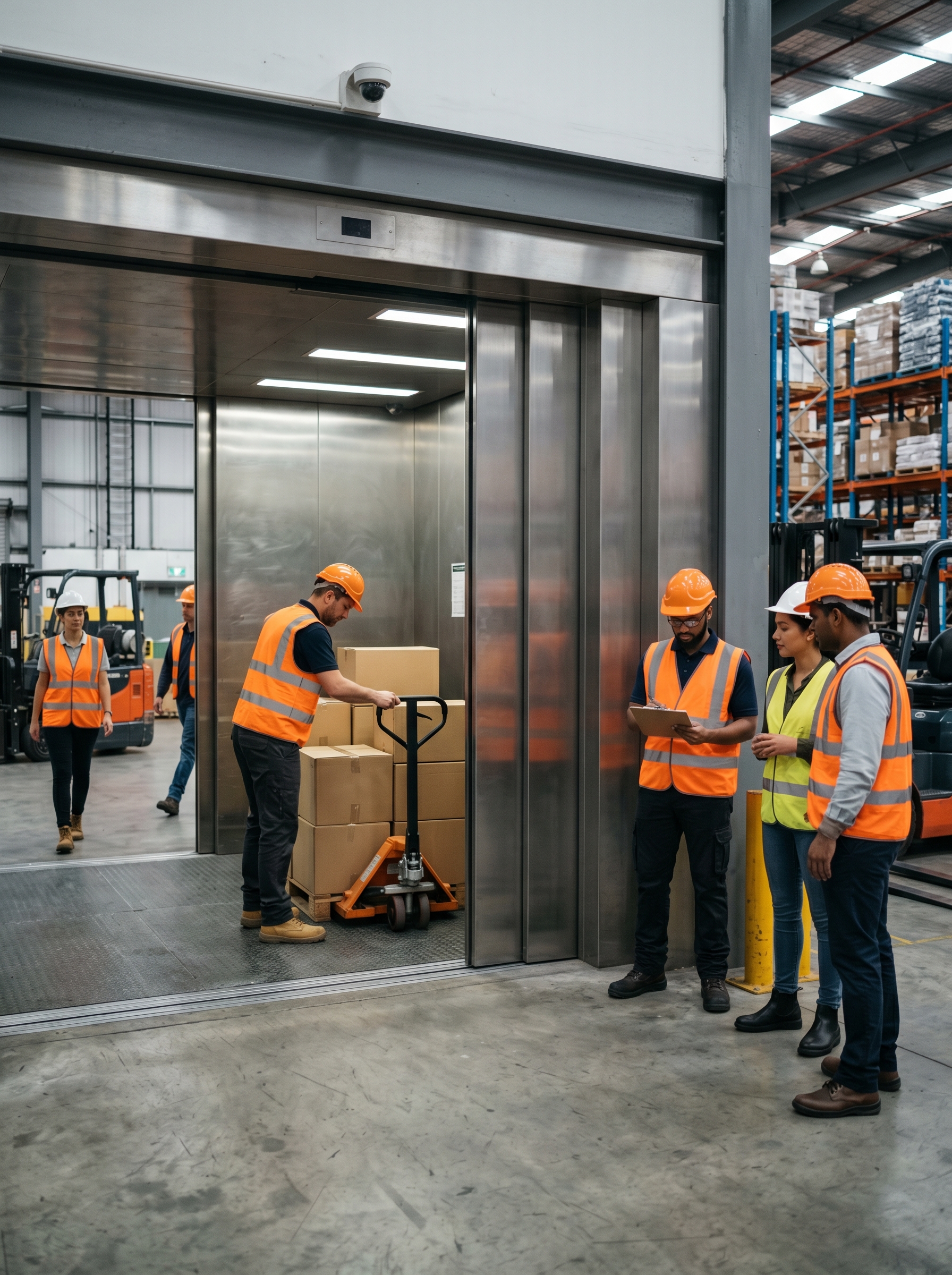
Cargo Elevator Safety Control
Real-time detection of overloading and risky behavior in elevators through intelligent vision to prevent large-scale human accidents.
Cargo Elevator Safety Management Is Not Simply a Matter of "Whether People are Visible"
In actual fields, at the moment the door opens, internal passengers, external waiters, and passing workers are all caught on one screen together, causing existing AI to repeatedly misunderstand the situation.
EVA started from that point. Not the existence of people, but reading the context of a dangerous situation. This case is an example showing how EVA is transforming complex safety issues in the field into a practical operating method.
Background: The Moment CCTV Missed, Danger in the Field Begins
Cargo elevators are originally spaces for transporting cargo, not people. Therefore, the field strictly limits the number of passengers to prevent cargo falls, jamming accidents, and accidents due to abnormal ride-sharing. The problem is that the actual operating environment is not that simple.
In logistics and manufacturing sites, workers sometimes stay together briefly to assist with cargo movement, and they also continue work while moving in and out of the elevator. In the short moment the door opens, both internal and external personnel are caught on one screen at the same time, and existing vision AI could not distinguish them. As a result, the system repeatedly sounded an alarm for 2 or more passengers even when only 1 person actually boarded inside the elevator, recognizing workers outside the door all as passengers.
The Clue to the Solution: We Needed AI That Understands Site Conditions (Why EVA?)
The customer judged that the problem could no longer be solved by the "ringing when a person is visible" method. What was needed was not simple object recognition, but AI that understands field conditions and distinguishes only real risks.
The reason EVA was selected was right here. EVA does not need to newly develop complex video recognition codes or relearn models from scratch for specific situations. Instead, prompt-based scenario setting that directly reflects the operating language of the field is possible.
For example, if you define the condition in an expression that the field manager understands, such as “Notify me when 2 or more people board while the elevator door is closed,” EVA configures the analysis criteria based on that intention. A structure that flexibly adapts to field conditions was created.
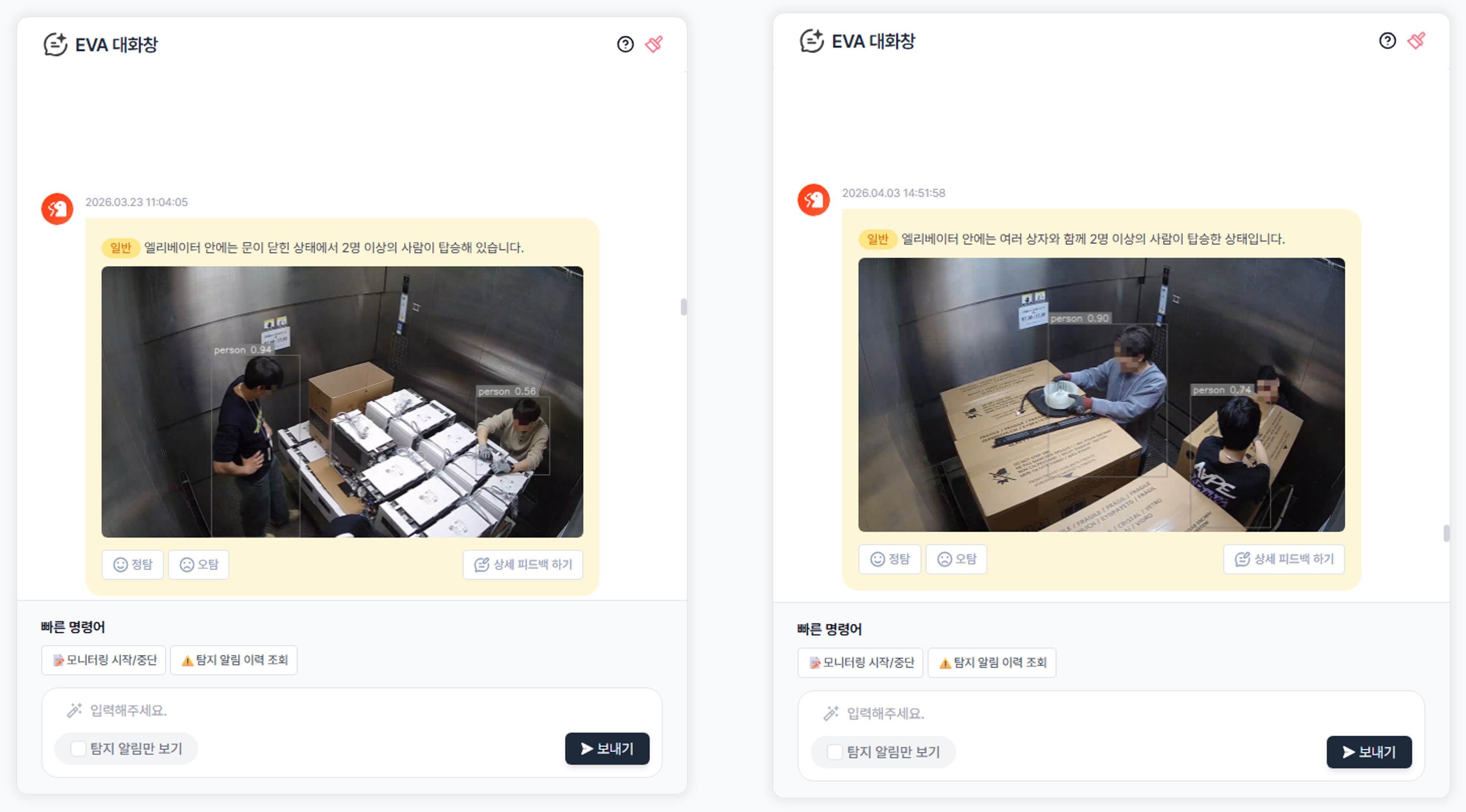
The fact that advanced context recognition is possible with only existing CCTVs without major changes to the existing infrastructure made EVA look like a realistic solution, not just an alternative.
The Process of Problem Solving: False Positives Decreased, and Only Real Risks Remained
The core of EVA is that it doesn't stop at simple detection. In this case, a 2-stage recognition structure of ML + VLM became the center of solving the problem.
- Stage 1 (ML): Primarily detects human objects in the video to grasp "where people are."
- Stage 2 (VLM): Interprets the context of the video based on natural language prompts and analyzes it to count only personnel inside the elevator.
Thanks to this structure, workers passing by the door or personnel standing around briefly when the door is open are excluded from passengers. On the other hand, an alarm occurs immediately if 2 or more people actually board inside the elevator. The alarm that used to ring every time the door opened is now operating only at really necessary moments.
This change goes beyond simply improving detection performance. The field developed a sense that "this notification can be trusted" for the first time. The most important thing in a safety system is not perfect automation, but reliability that the operator can trust and follow.
The Possibility Proved by EVA: The Meaning of the Alarm Has Come Back to Life
The first change confirmed in the PoC stage was the reduction of alarm fatigue. As unnecessarily repeated warnings decreased, field workers no longer accepted notifications as "annoying noises."
The second change confirmed was the effectiveness of the immediate response system. Since an alarm only occurs in actual multi-passenger situations, notifications can be sent quickly to managers and the field.
Third is the automation of the safety management proof system. Since timestamps, images, and descriptions are automatically recorded whenever an event occurs, it can also be used as evidence material for serious accidents.
Lastly, the fact that high-level context recognition is possible with existing CCTVs alone significantly lowers the barrier to entry. As a result, EVA recovered the trust of the field, revived the meaning of alarms, and proved a safety system applicable to actual operations.
Doesn't Your Site Have the Same Problem?
Alarms that ring repeatedly due to wrong recognition of people, untrustworthy notifications, and fatigue from repeated false positives appear commonly in many fields.
EVA is not simply a system that detects people. It's a safety partner that understands field conditions, distinguishes context, and responds only to truly dangerous situations. The more complex and sensitive the environment, like a cargo elevator, the greater the value of this context-aware AI.
Together with EVA, build a new standard of safety management that reduces unnecessary alarms and leaves only real risks now.