Forklift Critical Situation Focused Management
Preventing major industrial accidents like pedestrian collisions at forklift operation sites through intelligent scenario detection.
Forklift risks were always visible, but accidents couldn't be prevented
Forklifts are one of the most familiar pieces of equipment in manufacturing sites. They are the core means of transporting raw materials, moving loads, and keeping processes running without interruption.
EVA started from that point. Forklift-related risk situations, which had been regarded on-site as "unavoidable while working busily," began to enter the realm of predictable and manageable through EVA's intelligent vision.
Background: Risks were always within the screen, but the response was always one step behind
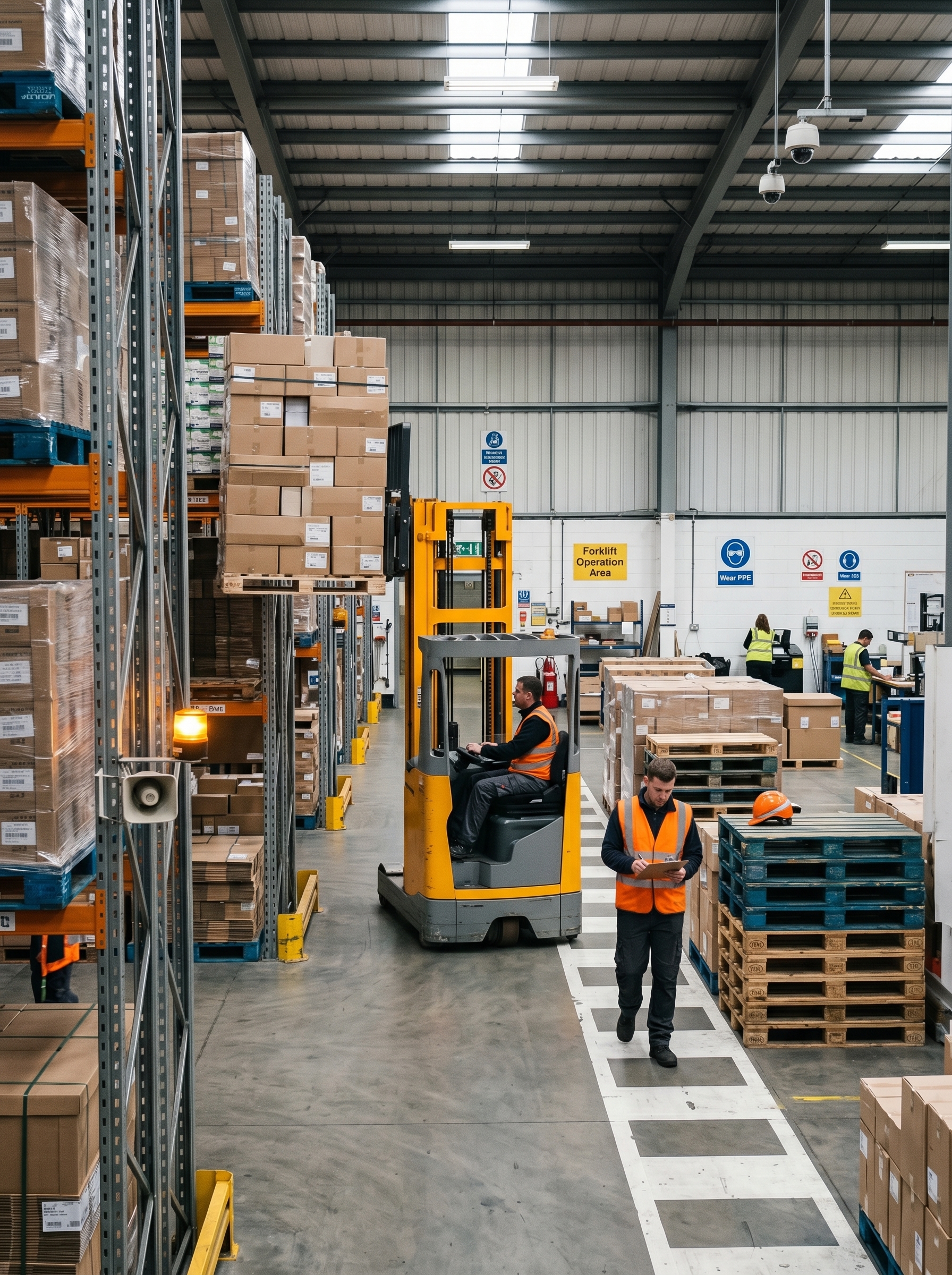
Forklift accidents* don't mostly happen only in spectacular abnormal situations. Rather, they start in scenes that are so familiar they're easy to just pass by on-site. A forklift loaded high with cargo moves with obscured visibility, a driver briefly boards without a helmet, and a worker enters near the forklift's working radius to shorten their route while busy.
All these scenes are captured on CCTV screens. But just because they're visible doesn't mean they can be responded to immediately. On-site control personnel had to watch dozens of screens simultaneously, and within them, they had to immediately judge "Is this combination actually a dangerous situation right now?" rather than the mere fact that "there is a person" or "a forklift is passing."
The problem was here. Conventional CCTV can record scenes, but it cannot read the moments of risk created by overlapping positional relationships, movement directions, and work contexts of people and equipment. In the end, what the site lacked was not cameras, but a judgment system that selects risks requiring intervention amid complex movements.
*Forklifts are the #1 source cause of fatal accidents in domestic industrial sites (Source: Ministry of Employment and Labor statistics)
Clue to Solution: EVA aimed to read the risk context of the site, not just see 'objects'
The EVA team didn't see this problem as a simple image recognition task. This was because the essence of forklift accidents isn't the fact that there are people and equipment in the frame, but the difficulty of reading in real-time when risk occurs amid complexly intertwined movements.
So the EVA team sought answers on-site, not at their desks. They directly observed factory noise, forklift movement trajectories, worker paths, and instantaneous entry and exit, organizing the "language of the field" that the VLM needs to understand one by one. On-site, even similar-looking scenes could be a routine work flow for some movements and a risk signal requiring immediate intervention for others. EVA had to be able to distinguish that difference.
There are many AIs that recognize things or people on the market. But the problem EVA wanted to solve wasn't simple object recognition. What matters isn't what's visible, but what risk context that scene is creating. To this end, EVA approached it with a context-understanding-based scenario detection method. For example, instead of just finding a person, it was designed to read combinations of scenes that increase the actual possibility of an accident as a single risk scenario—such as a worker approaching a forklift with visibility blocked by loads, a pedestrian entering a forklift-only zone, or entering the danger radius without a safety helmet.
The strength of EVA doesn't end with detection. After recognizing a risk, EVA has a structure that can be linked with Physical Action Triggers such as warning lights, speakers, and forklift interlocks so that it can be connected to the site's actual response. In other words, it doesn't just stop at leaving a record of the judgment that it's "dangerous," but also provides a foundation that can lead to immediate warnings and necessary physical control on-site.
Problem-Solving Process: Redefined scenes with high accident potential based on site standards
The first thing the EVA team did during the PoC process was to redefine dangerous scenes that occur repeatedly on-site. This was because the problem wasn't the "fact that there is a forklift," but when that forklift becomes an actual risk.
So EVA, together with the site, organized situations with a high possibility of accidents into specific scenarios one by one. Scenes that are easy to miss on actual sites—such as moving or turning with high loads, pedestrians or workers entering the forklift's working radius, or a driver leaving the designated waiting area during unloading—were structured as risk standards.
Afterward, adjustments continued so that these scenarios could be stably detected even in actual CCTV environments. This was because camera height, angle, lighting, and movement complexity differed for each site, so the same situation could look completely different in a video. Reflecting these differences, the EVA team sophisticatedly tuned the scenarios so that the AI could read not only objects but also the positional relationship, movement direction, and approach radius between people and forklifts.
Possibilities Proven by PoC: Accidents are no longer 'unavoidable', but controllable data
The PoC results were clear. Forklift-related risk situations, which had been regarded on-site as "unavoidable while working busily," began to enter the realm of predictable and manageable through EVA's intelligent vision.
During actual testing, EVA captured moments when forklifts approached each other excessively or when pedestrians entered forklift-only zones, providing immediate alarms. Through this, managers could perform more preemptive safety management based on risk threshold data provided by EVA, rather than relying on the method of mindlessly scanning multiple screens for risks.
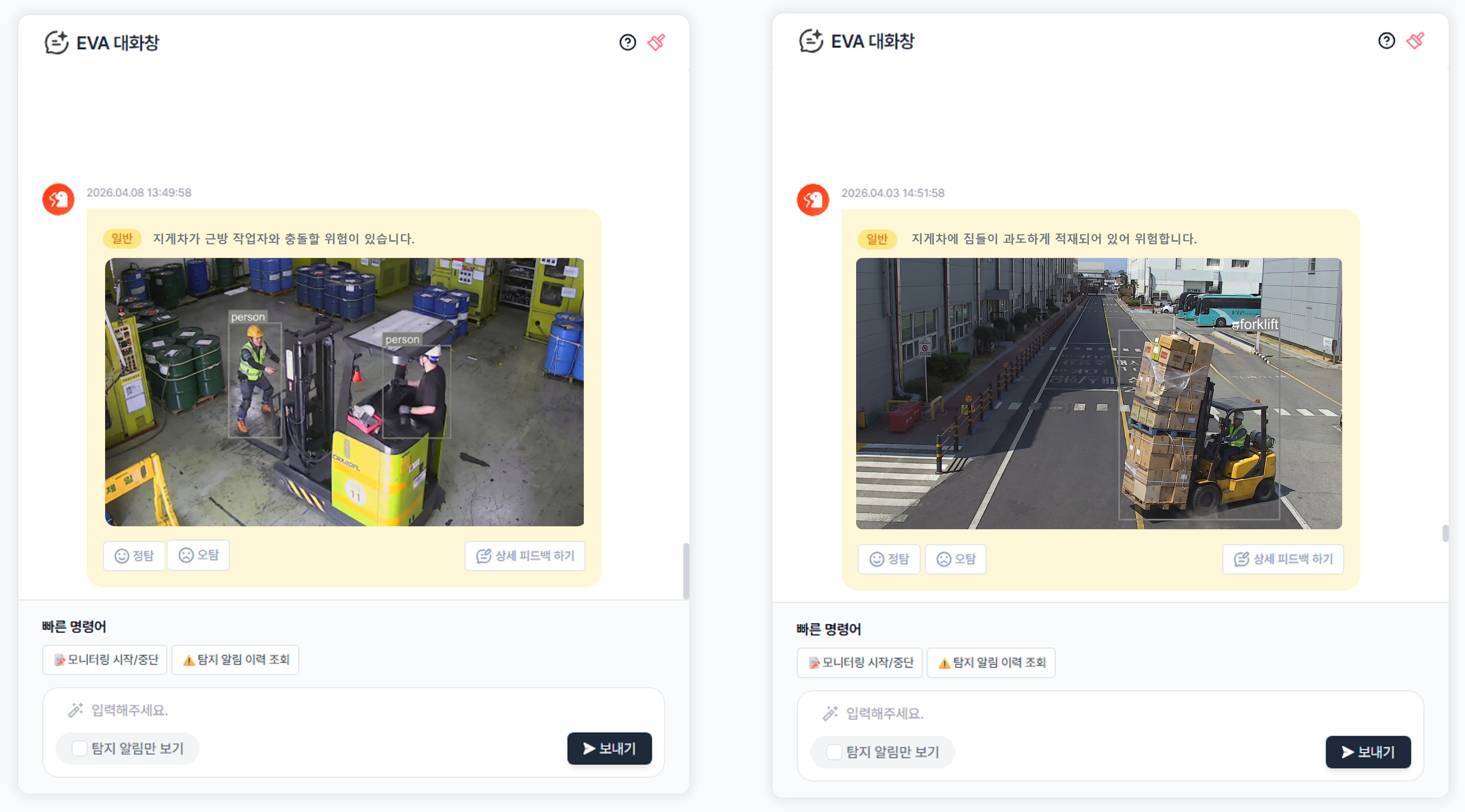
The most meaningful change was the reaction from the field. Workers experienced the fact that the AI checks for safety helmets and compliance with work zones in real-time and reacts immediately to dangerous situations. As a result, a virtuous cycle structure and behavioral changes within the site began to be created, leading to voluntary compliance with safety rules beyond simple monitoring.
Are you still leaving forklift risks to human eyes and luck?
Risks on-site are always within the screen. But it's difficult for a person to judge in real-time across all screens whether that scene is really dangerous and whether they should intervene now.
EVA is a practical AI that reads the context of risk and informs you first of the moments that require intervention in complex manufacturing sites where forklifts and workers are mixed.
If you need a safety system that actually protects the site beyond just recording CCTV, design "active safety" tailored to your site through EVA's PoC cases and demos.