LG Electronics Digital Park AI Safety Environment
LG Electronics Pyeongtaek Digital Park adopted EVA to enhance worker safety
and enable rapid responses to hazardous situations. Conventional AI CCTV systems operate based on pre-defined and limited scenarios,
making it difficult to flexibly respond to diverse variables and newly emerging risks in real-world environments.
EVA enables on-site requirements to be reflected immediately
through natural language and continuously expands detection scenarios,
supporting the establishment of a flexible and intelligent safety response system that adapts to evolving environments.
EVA x Cisco Intelligent Safety Environment
By integrating Cisco Meraki camera infrastructure with EVA,
an intelligent safety monitoring environment was established.
Safety managers can easily add cameras and define detection scenarios
using natural language without complex configurations or development.
This enables rapid reflection of on-site changes into the system and ensures real-time operational responsiveness.
A Flexible Safety System Focused on Real-Time Response
Key Detection Targets
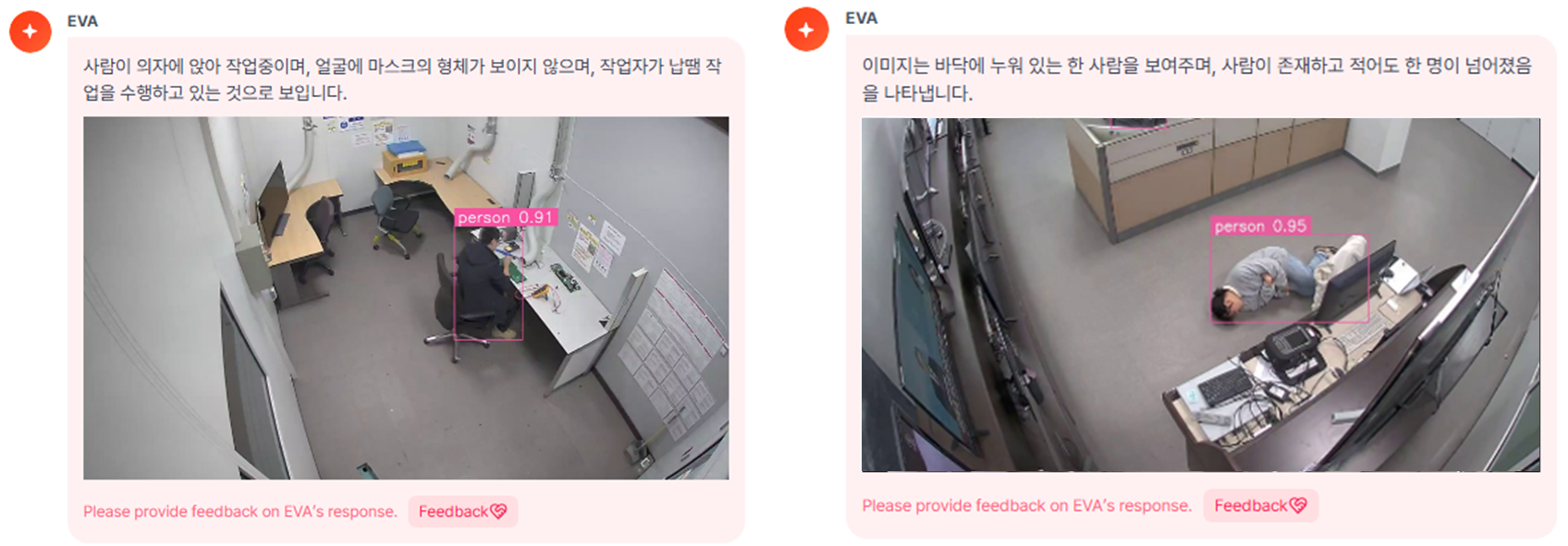
EVA continuously monitors compliance with protective equipment requirements such as masks and helmets based on hazardous material handling standards,
and detects abnormal situations such as collapse or prolonged inactivity
in 24-hour shift operations and single-worker environments.
Key Operational Activities
During the initial deployment of EVA, various false positives may occur due to
the complexity of real-world environments.
However, as on-site operators provide contextual explanations and feedback,
EVA progressively refines its decision criteria.
Through this process, detection accuracy continuously improves,
and below we introduce three representative activities that drove these improvements.
Activity 1 : Detection Scenario Enrichment
| Case | Phase 1 (Initial) | Phase 2 (False-Positive Description) | Phase 3 (Enrich Agent Structuring) |
|---|---|---|---|
| Fall Detection | Notify me if a person has fallen. | Exclude people sitting on chairs or standing, and notify only when a person is lying on the floor | Current Case Detect a person lying on the floor Detection Steps - A person is present - At least one person is lying on the floor Exceptions - Person is sitting on a chair or standing - Body visibility is insufficient - Difficult to distinguish from resting posture - More than 50% of the body is occluded - Occlusion by objects or structures on the floor |
| Mask Non-Compliance Detection | Notify me if someone is not wearing a mask | Exclude standing individuals, detect mask non-compliance among seated workers, exclude people using laptops or mobile phones | Current Case Detect mask non-compliance among seated workers Detection Steps - Person is seated - Person is working (activity recognition) - No mask detected on the face Exceptions - Working status is difficult to determine - Face or wearable items are occluded |
Simply listing conditions is insufficient to fully capture the complexity of real-world environments.
EVA progressively structures user explanations and exception cases,
enabling AI to understand not only what it should detect, but also what it should ignore.
The Enrich Agent plays a critical role in enhancing scenario completeness.
Activity 1 : Feedback on False Alarms
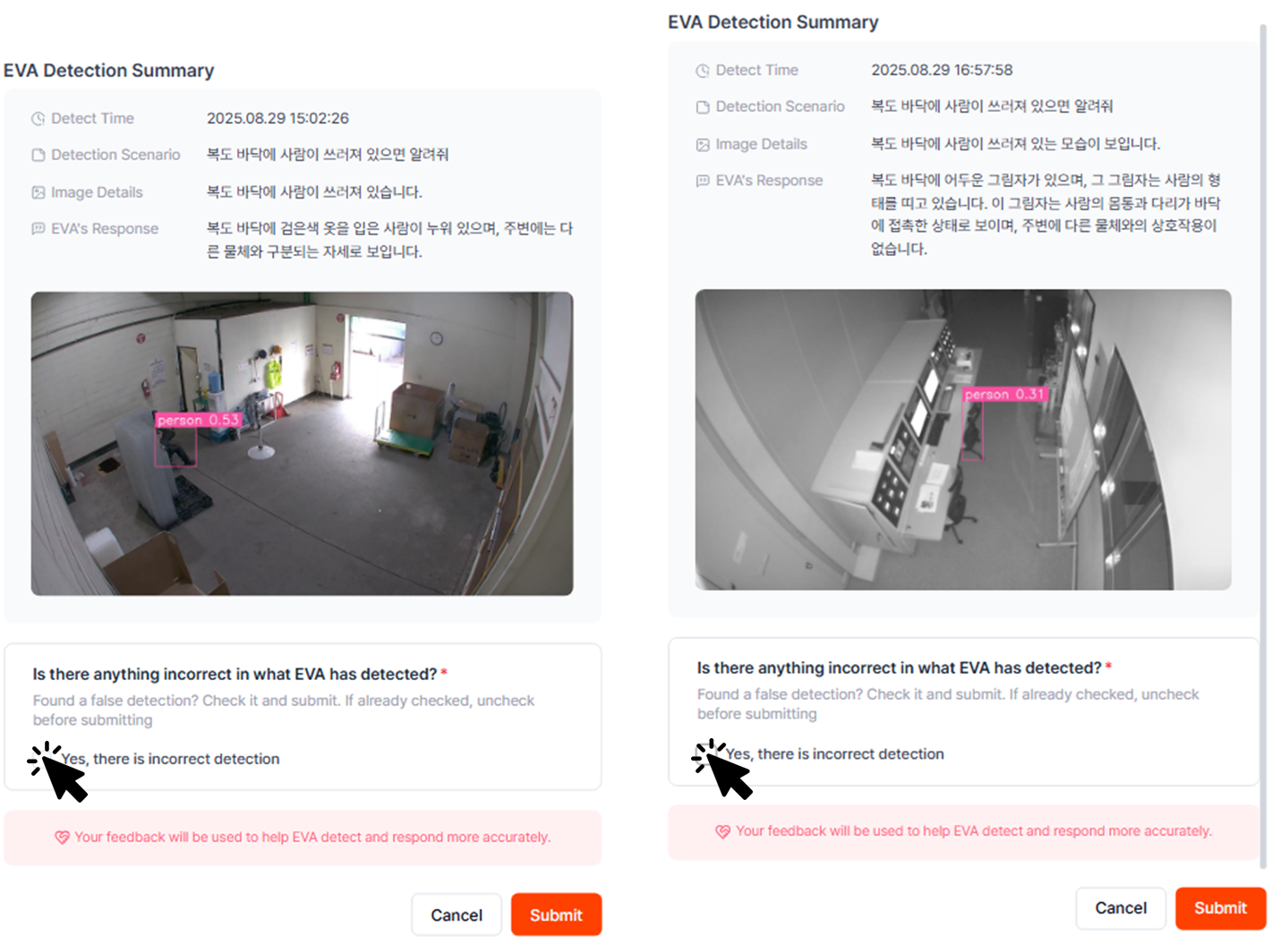
User feedback submitted during false alarms is stored in a VectorDB,
and leveraged to prevent the same alerts from recurring in similar situations.
Through over 250 accumulated feedback entries, EVA continuously learns on-site characteristics and refines its decision criteria.
This feedback loop is a core mechanism that increases system reliability over time.
Activity 2 : Foundation Model Updates
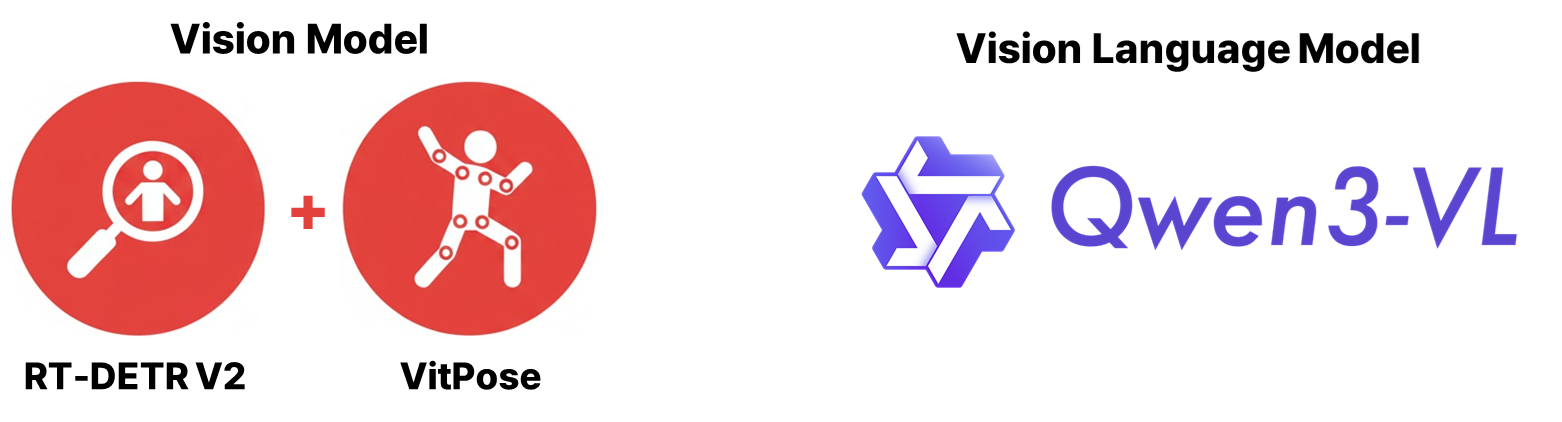
EVA is not locked into a specific model,
and can flexibly combine various Vision Models or transition to
the latest LLM and VLM models based on on-site requirements.
In this case, RT-DETR V2 was used for fast human detection,
while VitPose was combined to verify human posture and significantly reduce false positives.
Related technical details can be found in the Tech Blog.
In addition, continuous evaluation of newly released VLM models led to an update to Qwen3-VL 8B,
improving overall detection performance while achieving a 50% improvement in processing speed through model lightweighting.
Activity 3 : Zone-Based Detection
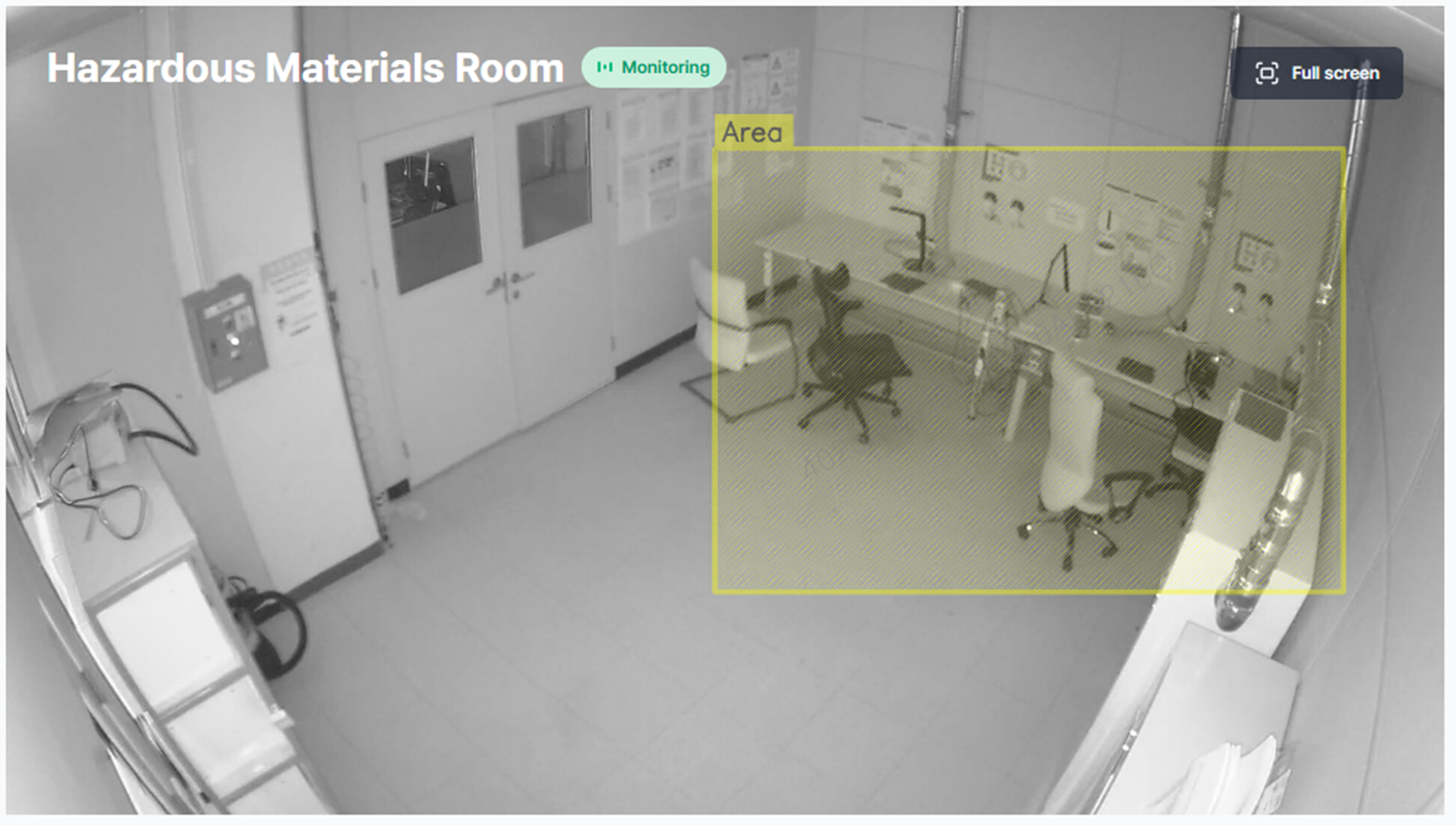
Starting from EVA v2.3.0, zone-based detection has been introduced.
Users can designate specific areas of interest, allowing EVA to focus exclusively on those zones,
effectively reducing false positives caused by irrelevant movements outside designated work areas.
EVA x Workflow Integration: From Detection to Action
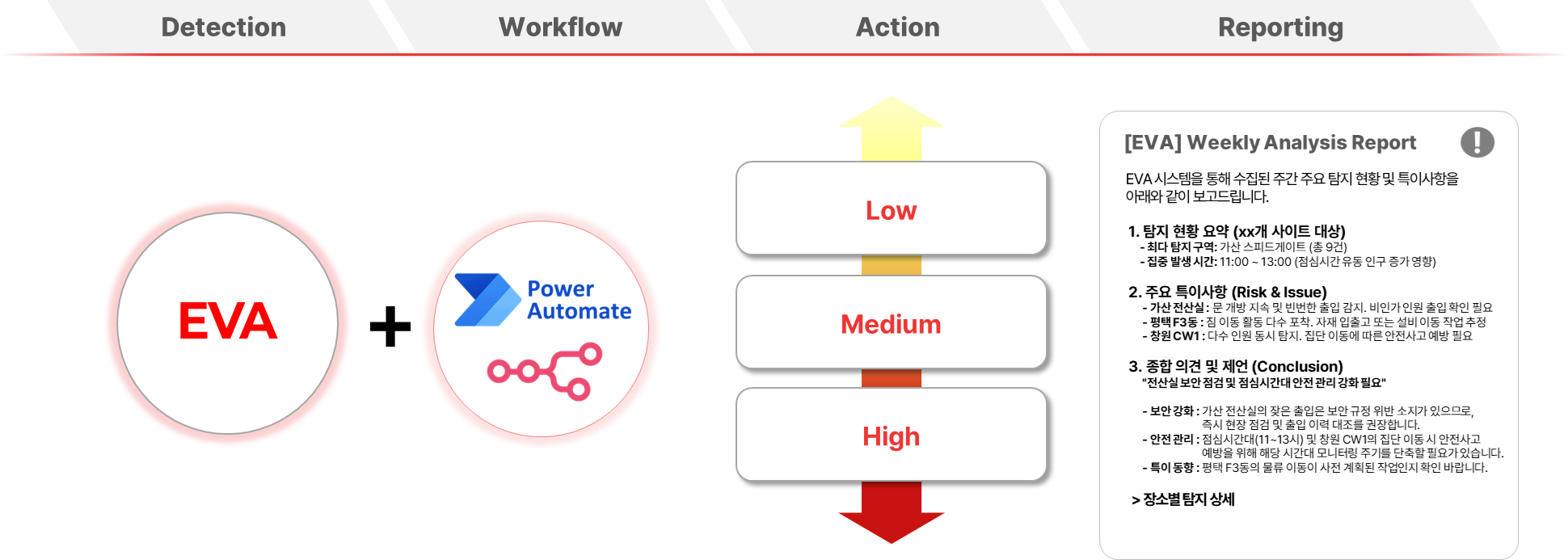
EVA’s detection results are integrated with the Workflow Builder to enable real operational actions.
By connecting with Power Automate and n8n,
automated response flows can be configured based on detection severity,
and detection outcomes are delivered as analytical reports to support managerial decision-making.
EVA x Workflow Integration: Physical Action Control
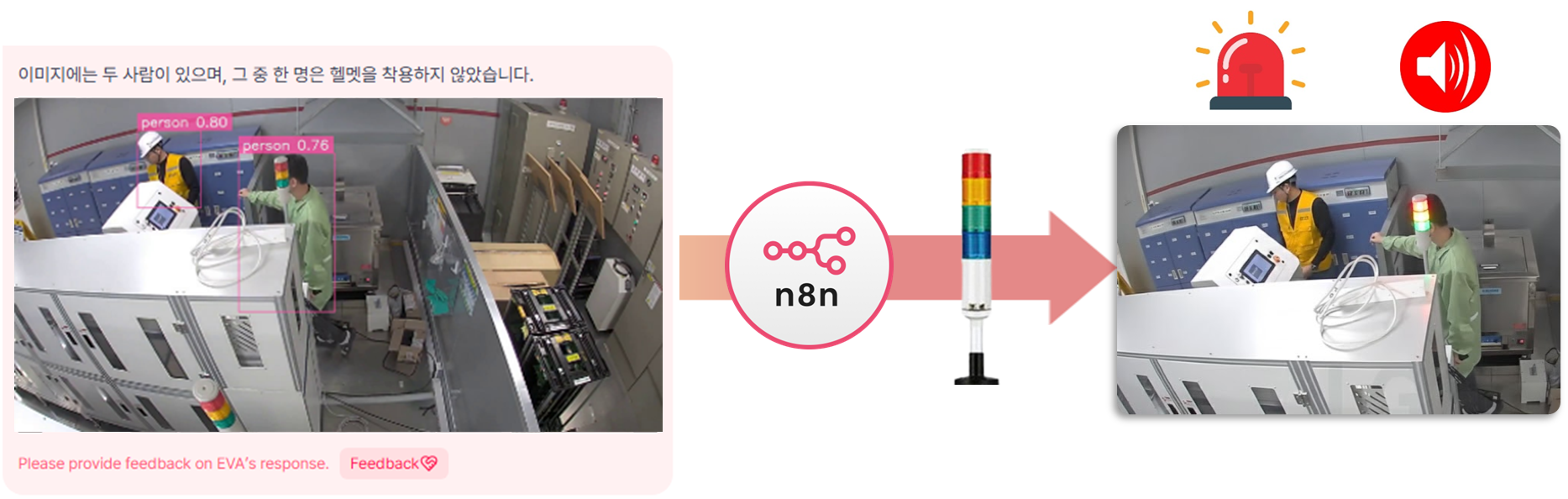
When critical risk situations are detected,
physical devices such as on-site sirens and emergency lights can be immediately controlled through workflows.
This enables EVA to evolve beyond a simple analytics tool into
an execution-driven safety platform that induces real-world actions.
Related details can be found in the Tech Blog.
Efficient Scalability
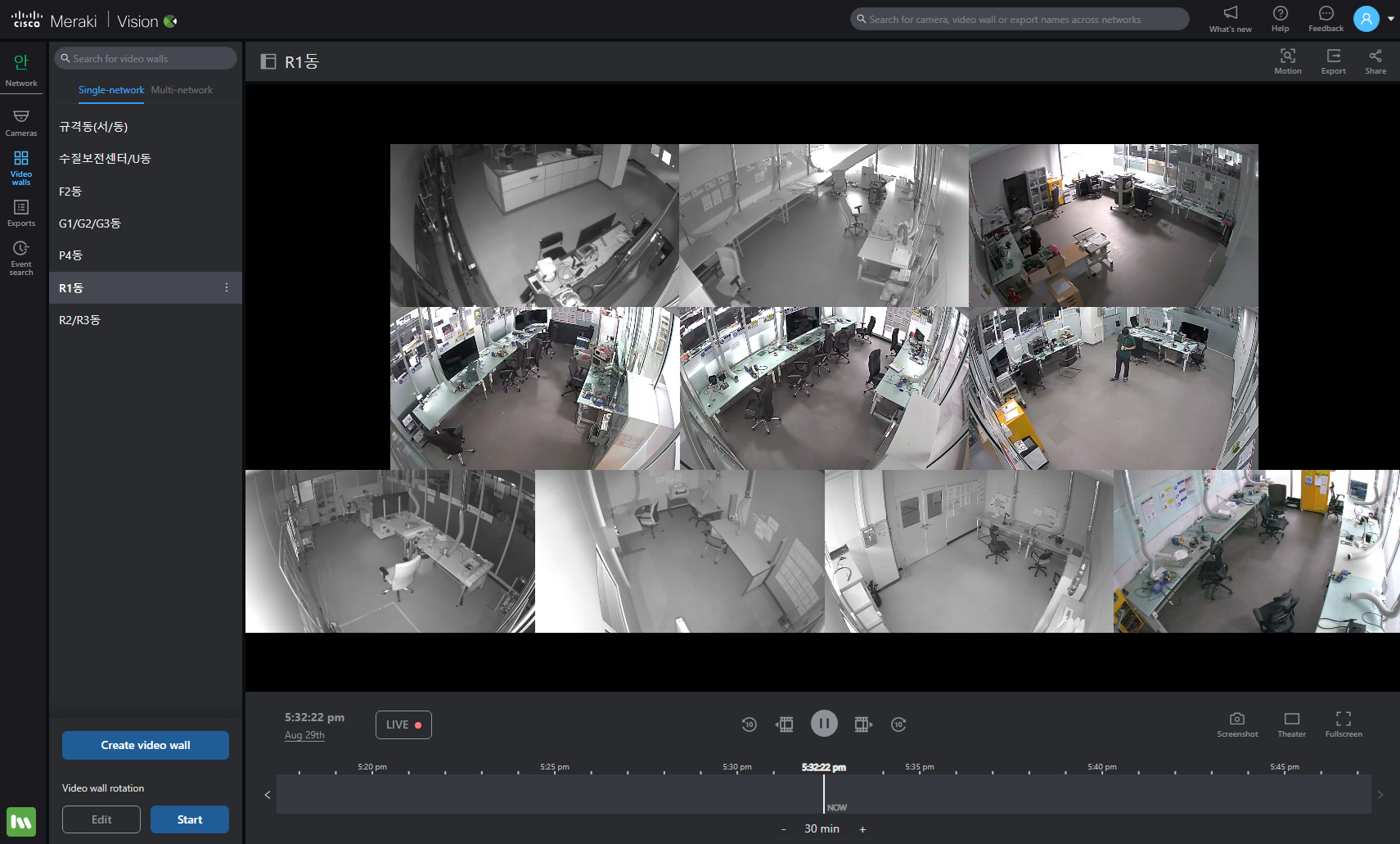
With simple integration into Cisco Meraki camera infrastructure, organizations can achieve both cloud-based scalability and flexible EVA-driven detection operations.
This provides a foundation for economically and efficiently expanding intelligent safety environments, even across large-scale industrial sites.