How EVA Evolved Requirement Management with Agent-Based Workflows


Beyond Simple Intake: Agents Handle Requirements
EVA uses AI Agents as core executors not only in development, but also throughout the requirement management process.
When a problem needs to be solved or a new improvement idea emerges in the field, the process begins simply by sending an email to eva-req@mellerikat.com.
What matters here is that writing the email itself does not need to be complicated.
Requesters do not need to spend time formatting their requests. Instead, they can briefly describe the pain points they experienced and the improvements they expect.
From that point forward, automated Agent workflows take over the refinement, analysis, and prioritization process.
1) Even Simple Emails Are Structured by Agents
Requesters focus on context rather than format when sending requirement emails.
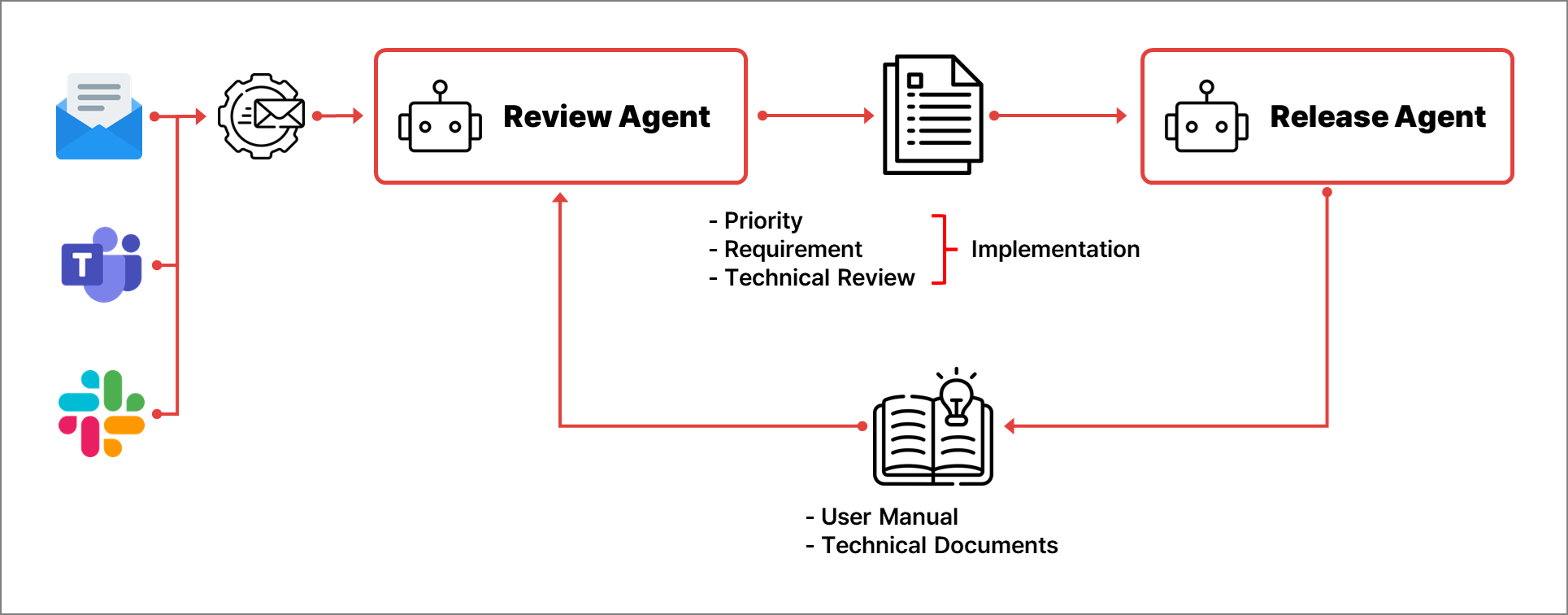
The Review Agent transforms these free-form inputs into structured requirements that can be directly reviewed by development teams.

During refinement, the Agent supplements missing context and converts ambiguous expressions into actionable language suitable for technical review.
In other words, this step transforms human-friendly input into a system-readable requirement structure.

At this stage, the requirement is no longer just a note—it becomes an organized unit that supports implementation review and priority assessment.
2) Analysis Based on EVA Manuals and Logic Documentation
Once refined, the requirement is analyzed together with EVA’s internal knowledge base.
This includes:
- User Manuals
- Technical and Logic Documentation
Using these documents, the Review Agent performs an initial analysis to identify affected areas, possible solution paths, and implementation priorities.
The analysis covers:
- Impacted features and logic
- Whether the issue can be resolved with existing functionality
- Whether new implementation is required
- Technical risks and expected impact
- Development priority
Through this process, a requirement evolves beyond simply describing what the problem is.
It becomes an executable development unit that explains how it can be solved and why it should be addressed now.
3) The Agent Loop Continues After Release
The workflow does not stop after implementation.
Once a release is completed, the Release Agent updates the manuals and logic documentation based on the latest changes.
These updated documents then become the knowledge base for future requirement analysis, allowing Agents to make increasingly accurate decisions as the product evolves.
The key point in EVA’s requirement operations is that this process is continuous.
Requirement collection, analysis, development, release, and documentation updates are all connected as a single automated loop without fragmentation.
Through this loop, Agents continuously learn from signals such as:
- Which requirements were actually implemented
- How they were resolved
- Which original expressions were unclear or inaccurate
The Review Agent structures inputs, analyzes them, and proposes priorities.
The Release Agent reflects implementation results back into documentation, enabling more accurate analysis for future incoming requirements.
In practice, this creates meaningful improvements such as:
- Higher requirement analysis accuracy
- Automatic detection and cleanup of duplicate requests
- Improved documentation quality
Conclusion: Agents Are Not Features, but Operational Processes
In EVA, Agents are not just assistive features for isolated tasks.
From the moment a requirement is submitted by email, Agents refine the content, analyze it based on manuals and logic documentation, derive priorities, and update documentation again after release.
In other words, EVA’s requirement management is not a manual process where people repeatedly format requests and organize follow-up work.
It is a workflow where AI Agents manage the entire lifecycle, structure information into maintainable forms, and accumulate knowledge for future decision-making.
As a result, requirements are no longer consumed as one-time requests.
They accumulate as operational data that helps define the product’s evolution more accurately.
EVA uses Agents not simply to automate tasks, but to turn requirement management itself into a continuously learning and improving operational process.